
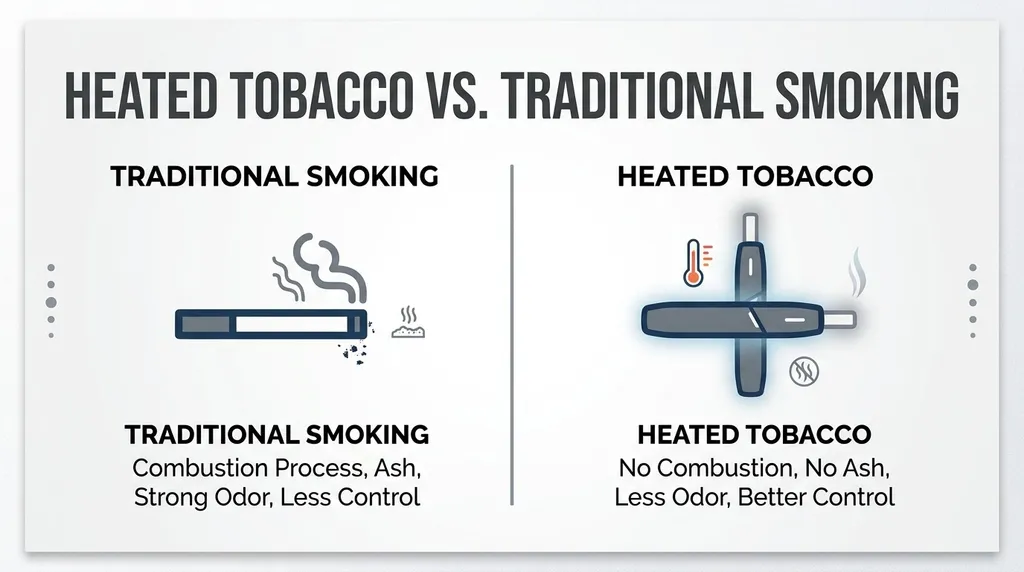
For over a century, smoking meant one thing: light a cigarette, watch it burn, and breathe in smoke. That picture is changing fast. Heated tobacco products have moved from a niche curiosity to a mainstream choice for adult smokers who want the same tobacco experience without some of the most obvious downsides of combustion — ash, lingering smell, and constant lighter fumbling. This shift isn't just about taste or trend. It's a genuine technological change in how tobacco is consumed, and it's worth understanding what actually separates these two approaches.
This article is written for adult smokers who are curious about the difference between heated tobacco and traditional cigarettes. It's not a health claim, a medical recommendation, or an invitation for non-smokers to start. Nicotine is addictive, and no tobacco product is risk-free.
Combustion vs. Heating: The Core Technological Difference
The single biggest difference between traditional cigarettes and heated tobacco devices comes down to temperature.
A traditional cigarette burns tobacco at temperatures that can reach 600–900°C. That combustion process is what produces smoke, ash, tar, and thousands of chemical byproducts — many of which come specifically from the burning process itself, not from the tobacco or nicotine alone.
Heated tobacco devices work differently. Instead of igniting the tobacco, they heat specially designed tobacco sticks at much lower temperatures, typically in the range of 250–350°C. This is enough to release flavor and nicotine-containing vapor, but not enough to trigger the combustion reaction that produces smoke and ash. The tobacco is warmed, not burned.
This distinction is the entire basis of the "heat-not-burn" category. It's a mechanical and chemical shift, not just a marketing label, and it changes almost every practical aspect of the experience.
No Ash, No Lingering Smell
Anyone who has smoked traditional cigarettes knows the aftermath: ash to clean up, and a smell that clings to clothes, furniture, curtains, and hair long after the cigarette is gone. That smell comes from the tar and particulate matter released during combustion, and it's notoriously difficult to fully eliminate from fabric or upholstery.
Because heated tobacco doesn't involve burning, it doesn't produce ash at all. There's no tray to empty, no butt to stub out, and no gray residue left behind. The odor profile is also dramatically different. Users and bystanders alike tend to notice that heated tobacco leaves a much lighter, less persistent scent compared to cigarette smoke, which tends to settle into a room and stay there for hours.
For people who smoke indoors, in cars, or in shared living spaces, this single difference often matters more than any other. It changes the social experience of smoking almost as much as the physical one.
A Smokeless Experience, Not a Smoke-Free Claim
It's worth being precise with language here. Heated tobacco is often described as producing "vapor" rather than "smoke," and this distinction matters technically. Smoke is a product of combustion — a mix of solid and liquid particles suspended in gas, formed when organic material burns. Vapor, by contrast, is formed when a substance is heated to the point of evaporation without burning.This is why heated tobacco is sometimes called a "smokeless" experience rather than a "smoke-free" one. There is still an aerosol being inhaled, and it still contains nicotine and other chemical compounds. The absence of visible smoke and the strong tobacco-burning smell doesn't mean the product is without effects or without nicotine — it means the delivery mechanism is fundamentally different.
For adult smokers evaluating their options, understanding this distinction is more useful than relying on marketing shorthand. The technology has changed how tobacco is consumed, but it hasn't changed the fact that nicotine remains present and habit-forming.
The Ritual Stays, the Byproducts Change
One reason heated tobacco has found a genuine audience among adult smokers — rather than just curious first-timers — is that it preserves much of the ritual associated with smoking. There's still a stick to insert, a device to hold, a puffing motion, and a defined session length. For smokers who value that familiar rhythm, heated tobacco can feel like a natural continuation rather than a complete departure.
What changes is what's left behind afterward. No ash tray. No cigarette butts. No need to step several meters away from a doorway because of how far the smell travels. This has made heated tobacco particularly popular in urban environments and among people who share living or working spaces with others who are sensitive to cigarette odor.
How Adult Smokers Are Accessing These Devices
As heated tobacco has grown from a niche product into a recognized category, the way people acquire devices and tobacco sticks has evolved too. It's no longer limited to specialty tobacco shops. Dedicated retailers now make it straightforward for verified adult users to order terea online dubai, browsing device options and stick flavors from home rather than searching multiple physical stores. This kind of accessibility has played a real role in the category's growth — when adult smokers can compare products and place an order without extra friction, adoption naturally follows.
The Shift Toward Digital Shopping for Tobacco Alternatives
Beyond just heated tobacco specifically, there's a broader pattern worth noting: tobacco alternatives, in general, have followed the same digital shopping trend seen across nearly every other consumer category. E-commerce convenience — clear product listings, straightforward checkout, and doorstep delivery — has reshaped how adult consumers approach purchases that once required an in-person visit.
This is reflected in how easily someone can nowterea buy online through dedicated platforms built specifically around this ecosystem. Rather than hunting for stock across different physical retailers, verified adult buyers can review available options, check flavor variants, and complete a purchase digitally. This mirrors the same convenience-driven shift that has reshaped grocery shopping, electronics, and countless other retail categories over the past decade — tobacco alternatives are simply the latest sector to follow that trajectory.
Weighing the Differences
Choosing between traditional cigarettes and heated tobacco isn't about declaring one universally "better." It's about understanding what each format actually delivers, mechanically and practically:
- Combustion vs. heating changes the byproducts produced during use.
- Ash and odor are largely eliminated with heated tobacco due to the absence of burning.
- Vapor vs. smoke is a real technical distinction, though nicotine and other compounds remain present in both formats.
- Ritual and routine are largely preserved in heated tobacco, which is part of why it appeals to existing smokers specifically.
- Access and convenience have both improved significantly as dedicated online retailers have entered the space.
Nicotine products, in any form, carry health risks and are intended only for adult users who already use tobacco. Anyone considering switching between formats — or considering quitting altogether — should speak with a healthcare professional for guidance suited to their individual situation.
The technology behind tobacco consumption has clearly shifted. Whether that shift matters to any individual smoker depends on what they value most: the familiar burn of a traditional cigarette, or the ash-free, lower-odor experience that heated tobacco is built around.